2026 Social Security COLA: Understanding the 3.2% Increase and Your Retirement

Anúncios
Anúncios
The 2026 Social Security COLA: How a 3.2% Increase Impacts Your Retirement Benefits
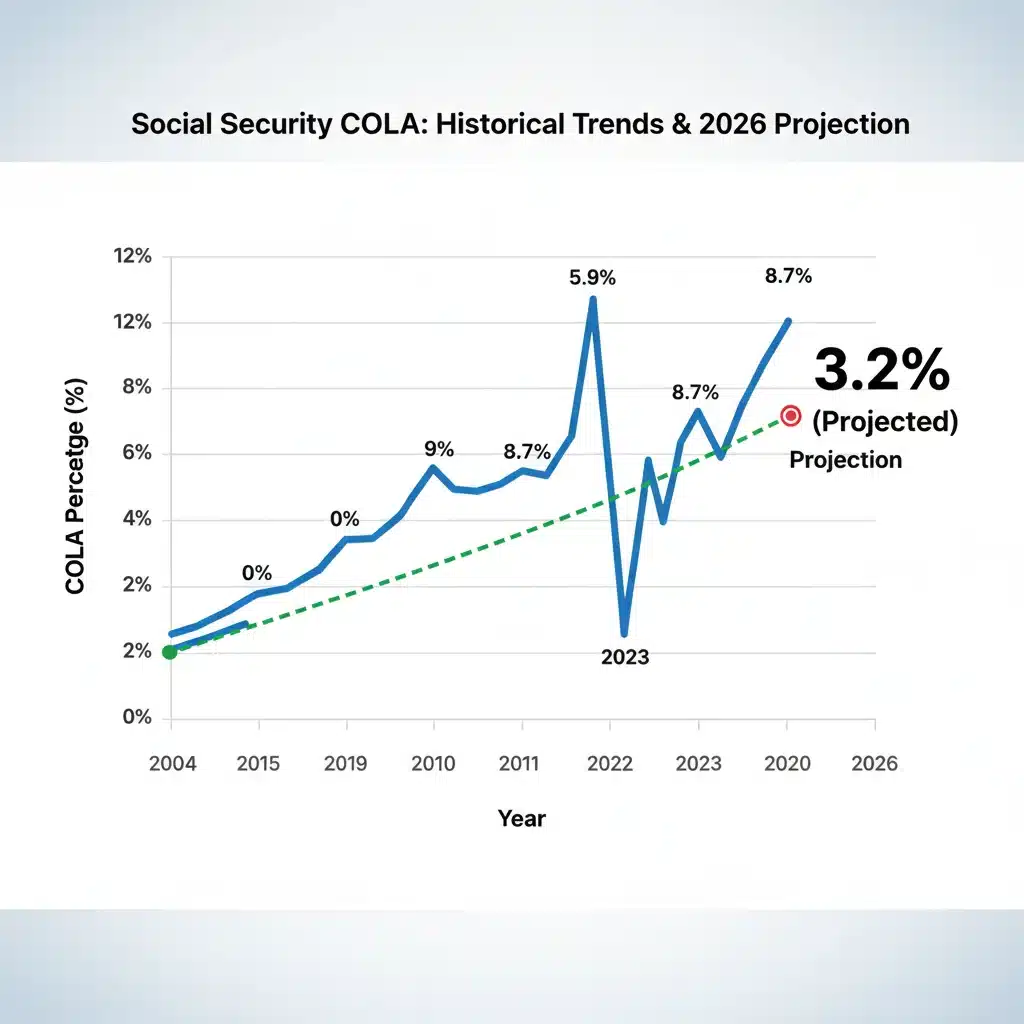
For millions of Americans, Social Security benefits are a cornerstone of their retirement income. These benefits, however, are not static. They are subject to annual adjustments known as Cost-of-Living Adjustments, or COLAs, designed to help beneficiaries keep pace with inflation. As we look ahead, projections suggest that the 2026 Social Security COLA could be around 3.2%. While this is still a projection, understanding what a 3.2% increase means, how it’s calculated, and its potential impact on your financial planning is crucial for current and future retirees. This comprehensive guide will delve into the intricacies of the 2026 Social Security COLA, offering insights into its calculation, implications, and strategies for maximizing your retirement security.
Understanding the Social Security COLA: A Foundation for the 2026 Social Security COLA
The Cost-of-Living Adjustment (COLA) is an annual increase in Social Security and Supplemental Security Income (SSI) benefits. Its primary purpose is to ensure that the purchasing power of these benefits is not eroded by inflation. Without COLAs, the fixed income of retirees would gradually lose value over time, making it harder to afford essential goods and services. The Social Security Administration (SSA) determines the COLA based on changes in the Consumer Price Index for Urban Wage Earners and Clerical Workers (CPI-W).
How is the COLA Calculated? The CPI-W Connection
The calculation of the COLA is a precise process. The SSA compares the average CPI-W for the third quarter of the current year (July, August, and September) with the average CPI-W for the third quarter of the last year in which a COLA was enacted. The percentage increase, if any, determines the COLA for the following year. For instance, to determine the 2026 Social Security COLA, the SSA will compare the CPI-W for Q3 2025 with the CPI-W for Q3 2024 (assuming a COLA is enacted in 2025, which is highly probable).
Anúncios
It’s important to note that if there is no increase in the CPI-W, or if it decreases, there will be no COLA. This happened in 2010, 2011, and 2016 when economic conditions led to no COLA being applied. However, such instances are relatively rare, as inflation is a persistent feature of most modern economies. The CPI-W specifically tracks the spending habits of urban wage earners and clerical workers, a demographic that is considered representative of the broader population’s exposure to price changes for everyday necessities. This index includes categories like food, housing, apparel, transportation, medical care, recreation, education, and communication. Understanding this underlying mechanism is key to grasping why the 2026 Social Security COLA projection of 3.2% is significant.
The Significance of the CPI-W for Beneficiaries
While the CPI-W is a broad measure, its direct impact on individual beneficiaries can vary. Some argue that the CPI-W doesn’t accurately reflect the spending patterns of seniors, who often have higher healthcare costs and different housing needs compared to the general urban wage earner population. There have been ongoing debates about whether a different index, such as the CPI-E (Consumer Price Index for the Elderly), would be more appropriate for calculating the Social Security COLA. However, for the foreseeable future, the CPI-W remains the official metric.
Projected 3.2% Increase: What the 2026 Social Security COLA Could Mean
A projected 3.2% increase for the 2026 Social Security COLA is a notable figure. To put this into perspective, let’s consider a hypothetical scenario. If an individual is currently receiving $1,800 per month in Social Security benefits, a 3.2% COLA would translate to an additional $57.60 per month, bringing their new monthly benefit to $1,857.60. While this might seem like a modest increase, over the course of a year, it adds up to an extra $691.20, which can make a significant difference in managing daily expenses, especially for those on a fixed income.
Impact on Average Benefits
To illustrate the broader impact, consider the average Social Security benefit. As of recent data, the average monthly benefit for retired workers is approximately $1,907. A 3.2% COLA on this average would increase it by about $61.02, bringing the new average to approximately $1,968.02. This collective increase across millions of beneficiaries injects substantial funds into the economy, helping maintain consumer spending power among seniors.
Inflationary Pressures and the 2026 Social Security COLA
The projection of a 3.2% COLA for 2026 suggests that inflation is expected to continue at a noticeable, albeit potentially moderating, pace. Recent years have seen higher COLAs due to elevated inflation, particularly in 2022 and 2023. While 3.2% is lower than some of the recent record-high adjustments, it still indicates that the cost of living is rising, and beneficiaries will need this adjustment to maintain their standard of living. Factors contributing to ongoing inflation can include supply chain issues, geopolitical events, energy costs, and robust consumer demand.
It’s crucial to remember that the COLA is a reactive measure. It reflects inflation that has already occurred. Therefore, while a 3.2% increase is welcome, it means that beneficiaries have already experienced a 3.2% rise in their cost of living over the preceding period. This lag is an inherent characteristic of the COLA system and underscores the importance of proactive financial planning.
Beyond the Percentage: Real-World Implications of the 2026 Social Security COLA
The 3.2% 2026 Social Security COLA is more than just a number; it has tangible effects on various aspects of retirees’ financial lives.
Medicare Premiums and the ‘Hold Harmless’ Provision
One of the most significant considerations is the interaction between the COLA and Medicare Part B premiums. Medicare Part B premiums are typically deducted directly from Social Security benefits. The ‘hold harmless’ provision is a critical protection for many beneficiaries. It states that an individual’s Medicare Part B premium increase cannot cause their net Social Security benefit to decrease from one year to the next. This provision primarily applies to about 70% of beneficiaries who have their Part B premiums deducted from their Social Security checks.
If the 2026 COLA is 3.2%, and Medicare Part B premiums also increase, the ‘hold harmless’ provision would ensure that the dollar increase in your Part B premium does not exceed the dollar increase in your Social Security benefit. This means your net benefit amount will either stay the same or increase, but never decrease, due to Part B premium hikes. However, for higher-income beneficiaries who pay an Income-Related Monthly Adjustment Amount (IRMAA) for Medicare Part B and Part D, the ‘hold harmless’ provision does not apply. These individuals may see a larger portion of their COLA absorbed by increased Medicare costs.
Income Tax on Social Security Benefits
Another important consideration is the potential for increased income tax liability. Social Security benefits can be taxable if your ‘provisional income’ exceeds certain thresholds. Provisional income includes your adjusted gross income (AGI), tax-exempt interest, and 50% of your Social Security benefits.
- For individual filers, if your provisional income is between $25,000 and $34,000, up to 50% of your benefits may be taxable.
- If your provisional income is above $34,000, up to 85% of your benefits may be taxable.
- For married couples filing jointly, these thresholds are $32,000 and $44,000, respectively.
A 3.2% increase in your Social Security benefits, combined with other retirement income, could push you into a higher provisional income bracket or increase the taxable portion of your benefits. This is a crucial aspect of financial planning that many retirees overlook. It underscores the importance of consulting with a tax advisor to understand how the 2026 Social Security COLA might affect your overall tax situation.
Impact on Other Government Benefits
For some beneficiaries, an increase in Social Security benefits due to the COLA could affect eligibility for other means-tested government programs. Programs like Medicaid, Supplemental Nutrition Assistance Program (SNAP), or housing assistance have income thresholds. While Social Security COLAs are designed to keep pace with inflation, even a modest increase could inadvertently push some individuals slightly above these thresholds, potentially reducing or eliminating their eligibility for these vital support systems. This is a complex area, and beneficiaries should review the specific rules of any programs they participate in.
Navigating Your Retirement with the 2026 Social Security COLA
Given the projected 3.2% 2026 Social Security COLA, proactive planning is more important than ever. Here are strategies to consider:
Re-evaluating Your Budget
Even with a COLA, it’s wise to regularly review and adjust your retirement budget. Account for rising costs in areas not fully captured by the COLA, such as out-of-pocket healthcare expenses, which can often increase faster than general inflation. A 3.2% increase might cover some rising costs, but it may not cover all of them, especially if you have specific high-cost needs.
Optimizing Your Investment Strategy
For those with investment portfolios, consider how inflation and the COLA might influence your withdrawal strategy. A balanced portfolio that includes inflation-protected securities (TIPS) or dividend-paying stocks might help mitigate the impact of rising prices. Work with a financial advisor to ensure your investment strategy aligns with your long-term retirement goals and risk tolerance.
Understanding Your Full Financial Picture
Social Security is often just one component of a broader retirement income strategy. Pensions, 401(k)s, IRAs, and personal savings all contribute to your financial security. Understand how the COLA interacts with these other income sources. For example, if you are still working part-time, your earnings might affect your Social Security benefits if you are below your full retirement age. The earnings limit changes annually, so it’s important to stay updated.
Considering Delayed Claiming Strategies
While the 2026 COLA will apply to benefits already being received, for those not yet claiming Social Security, delaying claiming can significantly increase your monthly benefit amount. For every year you delay claiming past your full retirement age (up to age 70), your benefit grows by 8% per year. This delayed retirement credit provides a guaranteed return and can be a powerful hedge against inflation over your retirement years, effectively magnifying the impact of future COLAs.
Future Outlook and Potential Reforms for the Social Security COLA
The discussion around Social Security COLAs is often intertwined with broader debates about the solvency of the Social Security system and potential reforms. While the 3.2% 2026 Social Security COLA is a current projection, the long-term future of COLA calculations and benefit levels remains a subject of ongoing policy discussions.
CPI-E vs. CPI-W Debate
As mentioned, there’s a persistent debate about using the CPI-E (Consumer Price Index for the Elderly) instead of the CPI-W. Proponents argue that the CPI-E more accurately reflects the spending patterns of seniors, particularly their higher healthcare costs, and would result in larger COLAs over time, better preserving the purchasing power of benefits for the elderly. Opponents counter that switching to CPI-E would further strain the Social Security trust funds.
Legislative Changes and Their Potential Impact
Various legislative proposals periodically emerge to address Social Security’s long-term financial challenges. Some proposals include modifying the COLA calculation, such as using a chained CPI, which generally grows more slowly than the CPI-W. Other proposals involve increasing the full retirement age, adjusting the payroll tax cap, or changing the benefit formula. Any such changes would have profound implications for future COLAs and overall benefit levels. Staying informed about these discussions is important for all current and future beneficiaries.
The Role of Economic Growth
The health of the overall economy plays a significant role in both inflation and the Social Security system. Robust economic growth can lead to higher wages, which in turn can increase tax revenues flowing into the Social Security trust funds. It can also influence inflationary pressures, which directly impact COLA calculations. A stable and growing economy provides a more favorable environment for maintaining the integrity of Social Security benefits and ensuring that COLAs remain meaningful.

Preparing for Your Retirement: A Holistic Approach
While the 2026 Social Security COLA provides a valuable adjustment, it’s essential to adopt a holistic approach to retirement planning. Relying solely on Social Security, even with annual COLAs, may not be sufficient for a comfortable retirement for many individuals. Diversifying income streams, saving diligently, and making informed decisions about claiming benefits are all critical components.
Consulting Financial Professionals
Working with a qualified financial advisor can provide personalized guidance tailored to your specific situation. An advisor can help you understand how COLAs, Medicare premiums, taxes, and your other assets interact. They can assist in creating a comprehensive retirement plan that accounts for inflation, longevity risk, and potential changes in Social Security policy. This professional insight can be invaluable in optimizing your financial well-being throughout retirement.
Staying Informed and Engaged
The landscape of Social Security and retirement benefits is dynamic. Staying informed about policy debates, economic trends, and legislative proposals is crucial. The Social Security Administration’s official website (SSA.gov) is an excellent resource for up-to-date information, benefit calculators, and personalized statements. Regularly checking your Social Security statement can help you track your earnings record and estimated future benefits, allowing you to plan more effectively.
Conclusion: The 2026 Social Security COLA and Your Financial Future
The projected 3.2% 2026 Social Security COLA represents a significant adjustment designed to help retirees manage the rising cost of living. While not finalized, this projection offers valuable insight into the economic environment and the potential increase in benefits for millions. Understanding how COLAs are calculated, their interaction with Medicare premiums and taxes, and their broader implications is fundamental to effective retirement planning.
As you navigate your retirement journey, remember that Social Security is a vital component, but it’s part of a larger financial ecosystem. By staying informed, budgeting wisely, optimizing your investments, and seeking professional advice, you can ensure that you are well-prepared to make the most of your benefits and achieve long-term financial security. The 2026 COLA, like all future adjustments, serves as a reminder of the continuous need for vigilance and proactive planning in securing a comfortable and dignified retirement.