
Bipartisan Infrastructure Bill Passes: A New Era for U.S. Roads and Bridges
The United States stands on the cusp of a monumental transformation in its infrastructure, thanks to the recent passage of the Bipartisan Infrastructure Bill. This landmark legislation, a testament to cross-party cooperation, is poised to inject a staggering $50 billion specifically into the vital arteries of the nation: its roads and bridges. With implementation slated to begin in January 2026, the Infrastructure Bill 2026 marks a critical turning point, promising not only to repair and modernize aging networks but also to stimulate economic growth, create jobs, and enhance the safety and efficiency of transportation for millions of Americans. This comprehensive legislative update delves into the intricacies of this bill, exploring its historical context, key provisions, anticipated impacts, and the long-term vision it embodies for a more robust and resilient America.
Anúncios
The Genesis of a Grand Vision: Understanding the Need for the Infrastructure Bill 2026
For decades, the state of American infrastructure has been a growing concern. Reports from organizations like the American Society of Civil Engineers (ASCE) have consistently highlighted the deteriorating condition of roads, bridges, and other critical public works, often assigning them dismal grades. Pothole-ridden highways, structurally deficient bridges, and outdated transit systems have not only posed safety risks but also hampered economic productivity, increased transportation costs, and diminished the nation’s global competitiveness. The urgency for substantial investment became undeniable, cutting across political divides and resonating with communities nationwide. The Infrastructure Bill 2026 emerged from this shared understanding, a recognition that deferred maintenance was no longer an option and that proactive investment was essential for future prosperity.
The journey to this legislative achievement was not without its challenges. Discussions around infrastructure funding have historically been fraught with partisan disagreements over scope, funding mechanisms, and priorities. However, the Bipartisan Infrastructure Bill managed to bridge these divides, demonstrating a collective will to address a pressing national need. Its passage signifies a significant shift in political dynamics, proving that complex, long-term challenges can be tackled through collaborative effort. This bill isn’t just about concrete and steel; it’s about a renewed commitment to the foundational elements that underpin societal function and economic dynamism. The focus on roads and bridges within the Infrastructure Bill 2026 is particularly crucial, as these elements form the backbone of both passenger and freight transportation, directly impacting supply chains, commuter times, and overall quality of life.
Anúncios
Key Provisions and Funding Allocation: What the $50 Billion Means
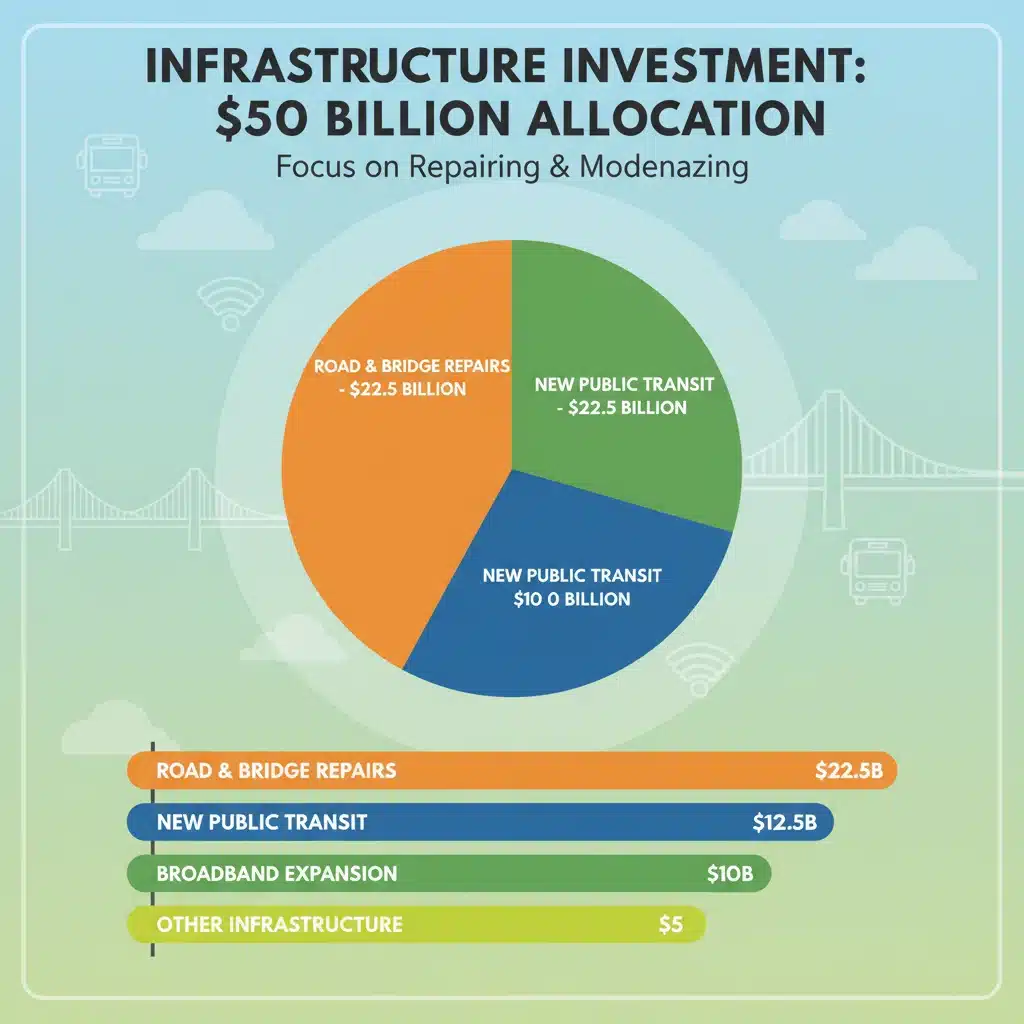
The Bipartisan Infrastructure Bill is an expansive piece of legislation, but its allocation of $50 billion specifically for road and bridge repairs is a cornerstone provision that warrants detailed examination. This significant sum is not merely a lump sum but is earmarked for a variety of initiatives designed to address the most critical needs across the country. The funding will be distributed through a combination of existing federal programs and new initiatives, ensuring that states and local governments have the resources to undertake ambitious projects. A substantial portion is expected to go towards repairing and rebuilding the nation’s 45,000 bridges that are currently in poor condition, as well as upgrading thousands of miles of roads that are past their prime.
Beyond basic repairs, the Infrastructure Bill 2026 also emphasizes modernization and resilience. This includes funding for projects that incorporate new technologies, such as smart road systems that can improve traffic flow and reduce congestion, and materials designed to withstand the impacts of climate change, like extreme weather events. The bill also prioritizes safety enhancements, aiming to reduce accidents and fatalities on highways. For instance, funding will be available for improving road signage, lighting, and implementing advanced driver assistance systems. This holistic approach ensures that the investment goes beyond simply patching problems, instead building a more robust, safer, and future-ready transportation network. The detailed allocation strategies will be crucial in determining which projects receive funding and how quickly they can be initiated once January 2026 arrives.

Economic Ripple Effects: Job Creation and Local Impact of the Infrastructure Bill 2026
The economic benefits of the Bipartisan Infrastructure Bill extend far beyond the direct act of repairing roads and bridges. The $50 billion investment is projected to be a powerful catalyst for job creation across various sectors. Thousands of new jobs will be generated in construction, engineering, manufacturing of building materials, and related support services. These are often well-paying jobs that can provide stable employment and opportunities for skill development, boosting local economies and supporting working families. Furthermore, the demand for raw materials like steel, concrete, and asphalt will invigorate domestic industries, creating a positive ripple effect throughout the supply chain. This focus on domestic production and job creation is a key component of the Infrastructure Bill 2026‘s broader economic strategy.
Beyond direct employment, improved infrastructure has a profound impact on overall economic efficiency. Reduced congestion, smoother roads, and reliable bridges mean lower transportation costs for businesses, faster delivery times for goods, and easier commutes for workers. This enhanced logistical efficiency can lead to increased productivity, attract new businesses to regions with superior infrastructure, and ultimately foster sustained economic growth. Small businesses, in particular, often bear the brunt of poor infrastructure through increased operational costs and delays; the upgrades funded by the Infrastructure Bill 2026 will provide them with a more favorable operating environment. The investment is not just a cost but a strategic economic stimulus, designed to yield significant returns in the form of a stronger, more competitive American economy.
Anticipated Challenges and Implementation Strategies for the Infrastructure Bill 2026
While the passage of the Bipartisan Infrastructure Bill is a cause for optimism, the successful implementation of its ambitious goals will not be without challenges. One primary hurdle will be the sheer scale of the projects. Coordinating thousands of road and bridge repairs across diverse geographic regions, often involving multiple governmental layers (federal, state, and local), requires robust planning and execution. Workforce availability, particularly for skilled trades, could also pose a challenge, necessitating investment in training and apprenticeship programs to ensure a sufficient labor pool. Furthermore, rising material costs and supply chain disruptions, which have become more prevalent in recent years, could impact project budgets and timelines. The effective deployment of the $50 billion allocated by the Infrastructure Bill 2026 will depend heavily on overcoming these practical obstacles.
To mitigate these challenges, states and localities will need to develop sophisticated implementation strategies. This includes prioritizing projects based on urgency and economic impact, leveraging innovative construction techniques, and ensuring transparency and accountability in spending. The federal government will likely play a crucial role in providing technical assistance and guidance, helping to streamline bureaucratic processes and facilitate inter-agency cooperation. Public-private partnerships could also become an important mechanism for financing and executing projects, bringing private sector efficiency and innovation to bear on public infrastructure needs. The success of the Infrastructure Bill 2026 will ultimately hinge on a collaborative effort from all stakeholders, demonstrating adaptability and strategic foresight in the face of complex logistical and economic realities.
Long-Term Vision: A Sustainable and Resilient Future Thanks to the Infrastructure Bill 2026
The Bipartisan Infrastructure Bill is not merely a short-term fix; it represents a long-term investment in the nation’s future. The focus on modernizing infrastructure goes hand-in-hand with building a more sustainable and resilient America. By incorporating advanced materials and engineering practices, the new roads and bridges will be better equipped to withstand the pressures of increased traffic, extreme weather events, and the passage of time. This forward-thinking approach aims to reduce the need for constant, costly repairs in the future, providing a more stable and predictable infrastructure network for generations to come. The emphasis on resilience is particularly important in an era of climate change, where infrastructure must be designed to endure and adapt to evolving environmental conditions. The Infrastructure Bill 2026 is a proactive step towards climate adaptation.
Moreover, the bill’s broader scope, while not exclusively focused on roads and bridges, sets a precedent for comprehensive infrastructure development. It acknowledges the interconnectedness of various infrastructure systems—from transportation to broadband, water pipes to power grids. The investments made in roads and bridges will complement other infrastructure improvements, creating a more integrated and efficient national system. This holistic vision is crucial for maintaining America’s competitive edge in the 21st century, ensuring that its physical backbone can support a dynamic economy and a high quality of life for its citizens. The legacy of the Infrastructure Bill 2026 will be measured not just in miles of repaired roads or rehabilitated bridges, but in the enduring strength and adaptability of the nation’s foundational systems.
How the Infrastructure Bill 2026 Impacts Everyday Americans
While discussions around legislative bills can often feel abstract, the Bipartisan Infrastructure Bill will have tangible, everyday impacts on the lives of ordinary Americans. For commuters, it means smoother, safer, and potentially faster journeys to work, school, and other destinations. Reduced traffic congestion due to improved road networks can translate into less time spent in cars and more time with families or pursuing personal interests. For consumers, the efficiency gains in freight transportation can lead to more stable prices and a wider availability of goods, as supply chains become more reliable. The safety enhancements, from better road surfaces to improved signage and lighting, will directly contribute to a reduction in accidents and fatalities, making travel inherently less risky. This direct benefit to public safety is a cornerstone of the Infrastructure Bill 2026‘s promise.
Beyond the immediate benefits, the bill also fosters a sense of national pride and progress. Seeing visible improvements in local infrastructure can instill confidence in government’s ability to deliver on essential services. For those living in areas with historically neglected infrastructure, the investments can bring about a renewed sense of opportunity and connection to the broader national economy. The creation of local jobs in construction and related industries will also provide economic stability for many families and communities. Ultimately, the Infrastructure Bill 2026 is designed to enhance the quality of life for all Americans, making their daily routines safer, more efficient, and more connected.
Looking Ahead: The Road to 2026 and Beyond
With the implementation of the Bipartisan Infrastructure Bill’s road and bridge funding set for January 2026, the coming years will be a period of intense planning, preparation, and initial project rollouts. States and municipalities are already beginning to assess their most critical needs and develop proposals to secure their share of the $50 billion. The federal agencies responsible for overseeing these funds will be establishing guidelines and technical assistance programs to ensure efficient and equitable distribution. This preparatory phase is crucial for laying the groundwork for successful execution once the funding officially becomes available. There will be a strong focus on ensuring that projects are shovel-ready and that bureaucratic hurdles are minimized to accelerate the pace of work.
As we move past 2026, the long-term impact of this investment will become increasingly evident. The goal is not just to fix what is broken but to build a modern infrastructure system that can support the nation’s needs for decades to come. This includes continuous monitoring of project outcomes, evaluation of economic and safety benefits, and adaptation of strategies based on lessons learned. The Infrastructure Bill 2026 represents a significant down payment on America’s future, but it also underscores the ongoing need for sustained investment and strategic foresight in maintaining and upgrading critical public assets. The journey of transforming American infrastructure is a continuous one, and this bill provides a powerful momentum for that journey.
Conclusion: A Historic Investment in America’s Foundation
The passage of the Bipartisan Infrastructure Bill, with its dedicated allocation of $50 billion for U.S. road and bridge repairs starting in January 2026, marks a truly historic moment for the nation. It signifies a collective commitment to addressing long-standing infrastructure deficits, enhancing public safety, stimulating economic growth, and building a more resilient and sustainable future. This legislation transcends partisan politics, demonstrating that when national interests are prioritized, significant progress can be achieved. The Infrastructure Bill 2026 is more than just a financial investment; it is an investment in the very fabric of American society, promising to upgrade the physical connections that bind communities, facilitate commerce, and enable the daily lives of millions. As the implementation date approaches, the anticipation for a revitalized American landscape, characterized by modern, safe, and efficient roads and bridges, continues to grow. This is a bold step forward, laying the groundwork for a stronger, more connected, and more prosperous America for generations to come.