The fiscal health of a nation is a cornerstone of its overall stability and prosperity. As we look ahead to the Federal Budget Outlook 2026, understanding the potential trajectories of government spending, revenue, and national debt becomes paramount. This comprehensive analysis aims to demystify the complex world of federal finances, offering insights into how the decisions made today and in the near future will shape the U.S. economic landscape and, crucially, your personal financial well-being.
Anúncios
The Federal Budget Outlook 2026 is not merely a collection of numbers; it’s a blueprint that reflects national priorities, economic assumptions, and the ongoing challenges facing the United States. From managing persistent deficits to addressing the rising costs of entitlement programs and navigating global economic uncertainties, the decisions made regarding the federal budget will have far-reaching consequences. This article will delve into the key components of the 2026 outlook, explore its potential impact on various sectors of the economy, and provide actionable advice for individuals seeking to safeguard and grow their finances in an evolving economic environment.
The U.S. federal budget is a dynamic entity, influenced by political priorities, economic cycles, and unforeseen global events. Projecting its state several years into the future, as with the Federal Budget Outlook 2026, involves a degree of uncertainty. However, by analyzing current trends, legislative proposals, and expert forecasts, we can identify key areas that are likely to define the fiscal landscape. This includes examining the trajectory of the national debt, the sustainability of social safety net programs, defense spending, and the potential for shifts in tax policy.
Anúncios
Understanding the Federal Budget Outlook 2026: Key Components
To grasp the full scope of the Federal Budget Outlook 2026, it’s essential to break down its core components. These include government revenues, expenditures, and the resulting budget deficit or surplus, all of which contribute to the national debt. Each component is influenced by a myriad of factors, from economic growth rates to legislative actions.
Government Revenues: Where the Money Comes From
The primary sources of federal revenue are individual income taxes, corporate income taxes, and social insurance taxes (Social Security and Medicare). The Federal Budget Outlook 2026 will largely depend on projections for economic growth, employment levels, and wage increases, as these directly impact tax collections. Policy changes, such as adjustments to tax rates or the introduction of new tax incentives, could also significantly alter the revenue stream. A robust economy generally leads to higher tax receipts, while an economic slowdown can quickly diminish government coffers.
For example, if economic growth in the lead-up to 2026 is stronger than anticipated, individual and corporate tax revenues could exceed projections, potentially reducing the deficit. Conversely, a weaker economy could exacerbate fiscal challenges. The political climate also plays a crucial role; debates around tax reform, such as changes to corporate tax rates or high-income individual taxes, could drastically reshape the revenue outlook.
Government Expenditures: Where the Money Goes
Federal spending is broadly categorized into mandatory spending, discretionary spending, and net interest on the national debt. Mandatory spending, which includes Social Security, Medicare, and Medicaid, constitutes the largest and fastest-growing portion of the budget. These programs are governed by eligibility rules and benefit formulas, making them difficult to adjust without legislative changes.
Discretionary spending, on the other hand, is subject to annual appropriations by Congress. This category includes defense, education, transportation, and various other government operations. The Federal Budget Outlook 2026 will reflect ongoing debates about national priorities and the allocation of resources across these diverse areas. For instance, increased geopolitical tensions might lead to higher defense spending, while calls for infrastructure modernization could boost investments in public works.
Net interest on the national debt is another critical and growing expenditure. As the national debt increases and interest rates rise, the cost of servicing that debt grows, consuming a larger share of the federal budget that could otherwise be used for other programs or deficit reduction. This particular component is highly sensitive to monetary policy decisions by the Federal Reserve.
Budget Deficits and National Debt: The Looming Challenge
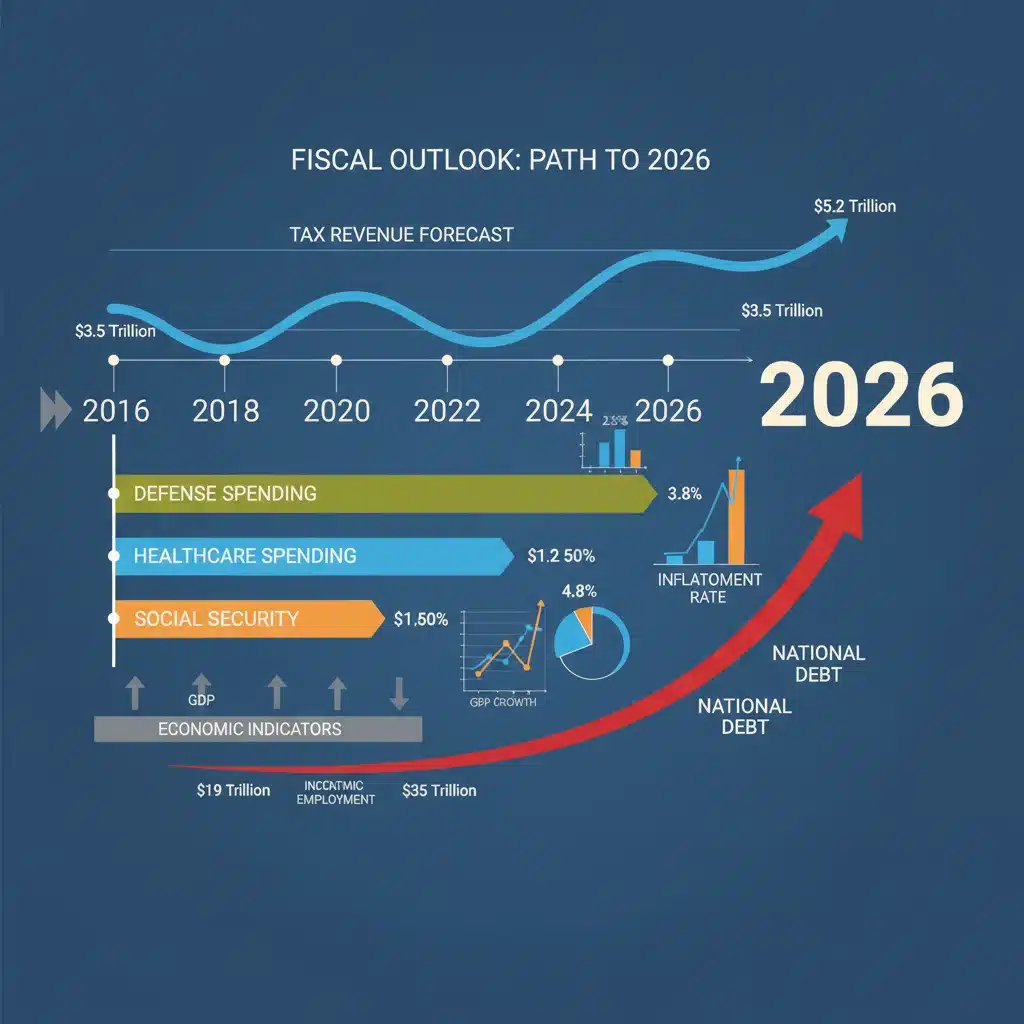
When expenditures exceed revenues, the government runs a budget deficit. These deficits accumulate to form the national debt. The Federal Budget Outlook 2026 is expected to continue to show significant deficits, contributing to an ever-growing national debt. This trajectory raises concerns about long-term fiscal sustainability, potential impacts on economic growth, and the nation’s ability to respond to future crises.
A persistently high national debt can lead to several adverse outcomes. It can crowd out private investment by increasing competition for capital, potentially leading to higher interest rates for businesses and consumers. It can also limit the government’s fiscal flexibility, making it harder to stimulate the economy during downturns or invest in critical areas like research and development.
Impact of the Federal Budget Outlook 2026 on U.S. Economic Stability
The Federal Budget Outlook 2026 has profound implications for the overall stability and performance of the U.S. economy. These impacts ripple through various economic indicators, affecting everything from inflation to interest rates and the labor market.
Inflationary Pressures
One of the most significant concerns stemming from the Federal Budget Outlook 2026 is its potential contribution to inflationary pressures. Large and sustained budget deficits, particularly if financed by an increase in the money supply, can lead to too much money chasing too few goods, driving up prices. Government spending, especially on programs that inject money directly into the economy without a corresponding increase in productive capacity, can also fuel inflation.
The balancing act for policymakers is challenging: stimulating economic growth without overheating the economy and triggering uncontrolled inflation. If the 2026 budget continues a trend of high deficits, the Federal Reserve might feel pressure to tighten monetary policy more aggressively to combat inflation, potentially leading to higher interest rates.
Interest Rates and Borrowing Costs
The relationship between the federal budget and interest rates is direct and critical. A growing national debt means the government must borrow more money, which increases the demand for credit in financial markets. This increased demand, all else being equal, can push up interest rates. Higher interest rates affect everyone: consumers pay more for mortgages, car loans, and credit card debt, while businesses face higher borrowing costs, potentially slowing investment and job creation.
The Federal Budget Outlook 2026 will be closely watched by the bond market. If investors perceive that the government’s fiscal path is unsustainable, they might demand higher interest rates to compensate for the increased risk, further exacerbating the cost of servicing the national debt. This could create a vicious cycle where rising debt leads to higher interest rates, which in turn leads to even higher debt service costs.
Economic Growth and Investment
The federal budget can either stimulate or constrain economic growth. Strategic investments in infrastructure, education, research, and development can boost productivity and long-term growth. However, if a significant portion of the budget is consumed by debt service or inefficient programs, it can crowd out private investment and hinder economic expansion.
The Federal Budget Outlook 2026 will reveal the extent to which fiscal policy is geared towards fostering a productive and competitive economy. Discussions around tax policy, for instance, can impact business investment decisions. Lower corporate taxes might incentivize companies to invest domestically, while higher taxes could lead to capital flight or reduced expansion plans.
Labor Market Dynamics
Government spending and tax policies outlined in the Federal Budget Outlook 2026 can also influence the labor market. Investments in specific sectors, such as green energy or technology, can create new jobs. Conversely, budget cuts in certain areas could lead to job losses. Tax policies, particularly those affecting payroll taxes or income tax rates, can impact incentives to work, save, and invest.
Furthermore, the long-term sustainability of programs like Social Security and Medicare, which are major components of federal spending, has direct implications for future retirees and the workforce. The outlook for these programs will shape expectations about retirement planning and healthcare costs for current and future generations.
Navigating Your Personal Finances Amidst the Federal Budget Outlook 2026
Understanding the broader economic picture painted by the Federal Budget Outlook 2026 is crucial for making informed personal financial decisions. The potential shifts in inflation, interest rates, and economic growth can directly impact your savings, investments, and daily expenses.
Preparing for Inflationary Environments
If the Federal Budget Outlook 2026 suggests continued inflationary pressures, it’s vital to adjust your financial strategies. Inflation erodes the purchasing power of money, meaning your savings buy less over time. Consider investments that traditionally perform well during inflationary periods, such as real estate, commodities, or inflation-protected securities (TIPS). Review your budget to identify areas where you can cut costs or increase income to maintain your purchasing power.
Also, evaluate your debt. Fixed-rate debt becomes less burdensome in real terms during inflation, while variable-rate debt can become more expensive. Prioritize paying down high-interest, variable-rate debts.
Adapting to Changing Interest Rates
The Federal Budget Outlook 2026, alongside the Federal Reserve’s monetary policy, will influence interest rates. If rates are expected to rise, consider locking in lower rates on mortgages or other long-term loans. For savers, rising interest rates can be a boon, as savings accounts, CDs, and bonds offer higher returns. However, bond prices typically move inversely to interest rates, so existing bond holdings might decrease in value.
When planning for retirement, consider how rising interest rates might affect your income streams from fixed-income investments. Diversifying your portfolio across various asset classes can help mitigate risks associated with interest rate fluctuations.
Investment Strategies for an Evolving Economy
The economic landscape shaped by the Federal Budget Outlook 2026 calls for a resilient investment strategy. Diversification remains key. Consider a mix of stocks, bonds, real estate, and potentially alternative investments. Focus on companies with strong fundamentals, stable cash flows, and pricing power, as these are better positioned to weather economic uncertainties and inflationary pressures.
Long-term investing, rather than trying to time the market, is often the most effective approach. Regularly review and rebalance your portfolio to ensure it aligns with your risk tolerance and financial goals, especially as economic conditions evolve.

Personal Budgeting and Debt Management
Regardless of the broader economic outlook, sound personal budgeting and debt management are always critical. The Federal Budget Outlook 2026 serves as a reminder to maintain an emergency fund, ideally covering three to six months of living expenses. This provides a buffer against unexpected financial shocks, such as job loss or unforeseen expenses, which can be more prevalent during periods of economic uncertainty.
Prioritize high-interest debt repayment, such as credit card balances, to free up cash flow and reduce financial stress. Explore opportunities to increase your income, whether through career advancement, side hustles, or investing in new skills. Financial literacy and continuous learning about economic trends will empower you to make more informed decisions.
Retirement Planning in Light of Fiscal Challenges
The long-term fiscal challenges highlighted by the Federal Budget Outlook 2026, particularly concerning the sustainability of Social Security and Medicare, underscore the importance of robust personal retirement planning. While these programs are vital, relying solely on them for retirement income may not be prudent.
Maximize contributions to tax-advantaged retirement accounts like 401(k)s and IRAs. Consider consulting with a financial advisor to develop a comprehensive retirement plan that accounts for potential changes in government benefits, inflation, and healthcare costs in retirement. Diversify your retirement savings across different investment vehicles and consider strategies that generate passive income.
Potential Policy Responses to the Federal Budget Outlook 2026
Addressing the challenges presented by the Federal Budget Outlook 2026 will require difficult policy choices. Policymakers have several levers they can pull, each with its own set of economic and political implications.
Revenue-Side Adjustments
One approach to improving the Federal Budget Outlook 2026 is to increase government revenues. This could involve raising income tax rates for individuals or corporations, broadening the tax base by eliminating deductions or loopholes, or introducing new taxes (e.g., a carbon tax or a value-added tax). Each of these options faces significant political hurdles and could have varying impacts on economic growth and income distribution.
For example, raising corporate taxes might discourage business investment, while increasing individual income taxes could affect consumer spending. The challenge lies in finding a balance that generates sufficient revenue without stifling economic activity.
Expenditure-Side Reforms
Another path involves reining in government spending. This could mean cuts to discretionary programs, which are often politically contentious, or reforms to mandatory spending programs like Social Security and Medicare. Given that these entitlement programs are the largest and fastest-growing components of the budget, any meaningful long-term fiscal improvement would likely require addressing their sustainability.
Potential reforms to Social Security might include raising the full retirement age, adjusting the cost-of-living allowance (COLA) formula, or increasing the payroll tax cap. For Medicare, options could involve adjusting eligibility, increasing deductibles, or implementing reforms to control healthcare costs. These are highly sensitive issues with significant social and political implications.
Debt Management Strategies
Beyond revenue and expenditure adjustments, policymakers might also consider strategies to manage the national debt more effectively. This could involve policies aimed at accelerating economic growth, which naturally increases tax revenues, or exploring innovative financing mechanisms. However, the most direct way to manage debt is by reducing future deficits through a combination of spending cuts and revenue increases.
The Federal Budget Outlook 2026 will likely emphasize the need for a credible long-term fiscal plan to reassure financial markets and maintain investor confidence in U.S. government debt.
Conclusion: Preparing for the Future Fiscal Landscape
The Federal Budget Outlook 2026 presents a complex and evolving picture for the U.S. economy and individual finances. While the exact trajectory remains uncertain, the underlying trends of persistent deficits, growing national debt, and the increasing costs of entitlement programs suggest that significant fiscal challenges lie ahead. These challenges could manifest as continued inflationary pressures, higher interest rates, and potential shifts in economic growth patterns.
For individuals, understanding these macroeconomic forces is not just an academic exercise; it’s a critical component of sound financial planning. By proactively adjusting personal budgets, diversifying investment portfolios, managing debt strategically, and planning robustly for retirement, you can better navigate the economic landscape shaped by the Federal Budget Outlook 2026. Engaging with financial news and expert analysis will help you stay informed and adapt your strategies as new information becomes available.
Ultimately, the future of the federal budget will be determined by policy choices made by elected officials. As citizens, being informed and advocating for fiscal responsibility are also crucial roles in shaping a stable and prosperous economic future for the United States. The journey to 2026 and beyond will be one of continuous adaptation and strategic financial management.