Federal Student Aid Updates 2026: FAFSA Changes & Pell Grant Max $7,395

Anúncios
Securing an affordable education is a paramount concern for millions of students and families across the United States. As tuition costs continue to rise, Federal Student Aid remains a critical lifeline, providing billions of dollars in grants, loans, and work-study opportunities. With the academic year 2026-2027 on the horizon, it’s essential for prospective and current students to understand the anticipated changes and updates to the Federal Student Aid landscape, particularly regarding the Free Application for Federal Student Aid (FAFSA) and the Pell Grant program.
The past few years have brought significant transformations to the financial aid system, aimed at simplifying the application process and expanding eligibility. These changes, primarily stemming from the FAFSA Simplification Act, are designed to make higher education more accessible and affordable. This comprehensive guide will delve into the key updates for Federal Student Aid 2026, focusing on how these adjustments will impact your eligibility, the application process, and your potential to secure vital funding like the Pell Grant, which could provide up to $7,395 for eligible students.
Anúncios
Understanding these developments is not just about filling out a form; it’s about strategizing your educational funding. From navigating the revamped FAFSA to maximizing your Pell Grant potential and exploring other aid options, this article will equip you with the knowledge needed to confidently pursue your academic dreams. Let’s explore the future of Federal Student Aid and how you can best prepare for 2026.
The FAFSA Simplification Act: A New Era for Federal Student Aid
The FAFSA Simplification Act represents the most significant overhaul of the federal student aid system in decades. Signed into law as part of the Consolidated Appropriations Act of 2021, its full implementation has been a multi-year process, with many of its core provisions taking effect for the 2024-2025 aid year and continuing to evolve into 2026. The primary goals of this act are clear: streamline the FAFSA, expand eligibility for federal student aid, and provide a more accurate assessment of a family’s financial need.
Anúncios
Key Changes Introduced by the Simplification Act
Several pivotal changes have reshaped the FAFSA and, by extension, the entire Federal Student Aid ecosystem:
- Simplified FAFSA Form: The notoriously complex FAFSA has been significantly shortened, moving from over 100 questions to approximately 36. This reduction aims to make the application process less daunting and time-consuming for students and families. The new FAFSA interface is designed to be more user-friendly and intuitive.
- Introduction of the Student Aid Index (SAI): The Expected Family Contribution (EFC) has been replaced by the Student Aid Index (SAI). While both are indices of a student’s ability to pay for college, the SAI calculation is intended to be more equitable. A key difference is that the SAI can be a negative number, meaning students with significant financial need could qualify for more aid.
- Direct Data Exchange with IRS: A major improvement is the direct data exchange with the IRS. Applicants (and their parents/spouses, if applicable) will be required to provide consent for the direct transfer of their tax information from the IRS to the FAFSA. This eliminates the need for manual entry of tax data, reducing errors and simplifying the process.
- Expanded Pell Grant Eligibility: The Simplification Act significantly expands eligibility for Pell Grants, tying it more directly to the federal poverty level and family size, rather than solely relying on the SAI. This is a game-changer for many low-income students.
- Removal of Certain Questions: Questions related to selective service registration and drug conviction history have been removed from the FAFSA, reducing barriers to aid for certain populations.
- Changes to Family Farm and Small Business Asset Reporting: The treatment of family farm and small business assets has been revised, potentially affecting how these assets impact a student’s aid eligibility.
- Federal Tax Information (FTI) Requirement: All contributors (student, parent(s), spouse) on the FAFSA must provide consent for the U.S. Department of Education to receive their federal tax information directly from the IRS. Without this consent, the FAFSA cannot be processed, and the student will not be eligible for Federal Student Aid.
These changes are not merely administrative; they represent a fundamental shift in how the government assesses financial need and allocates resources. For Federal Student Aid 2026, these new rules will be fully integrated, making it crucial for applicants to understand their implications.
Understanding the Student Aid Index (SAI) for Federal Student Aid 2026
The transition from the Expected Family Contribution (EFC) to the Student Aid Index (SAI) is one of the most impactful changes for Federal Student Aid 2026. The SAI is a number that colleges use to determine how much federal student aid a student is eligible to receive. It’s not the amount of money your family will have to pay, but rather an index used in a formula to calculate your financial need.
How the SAI is Calculated
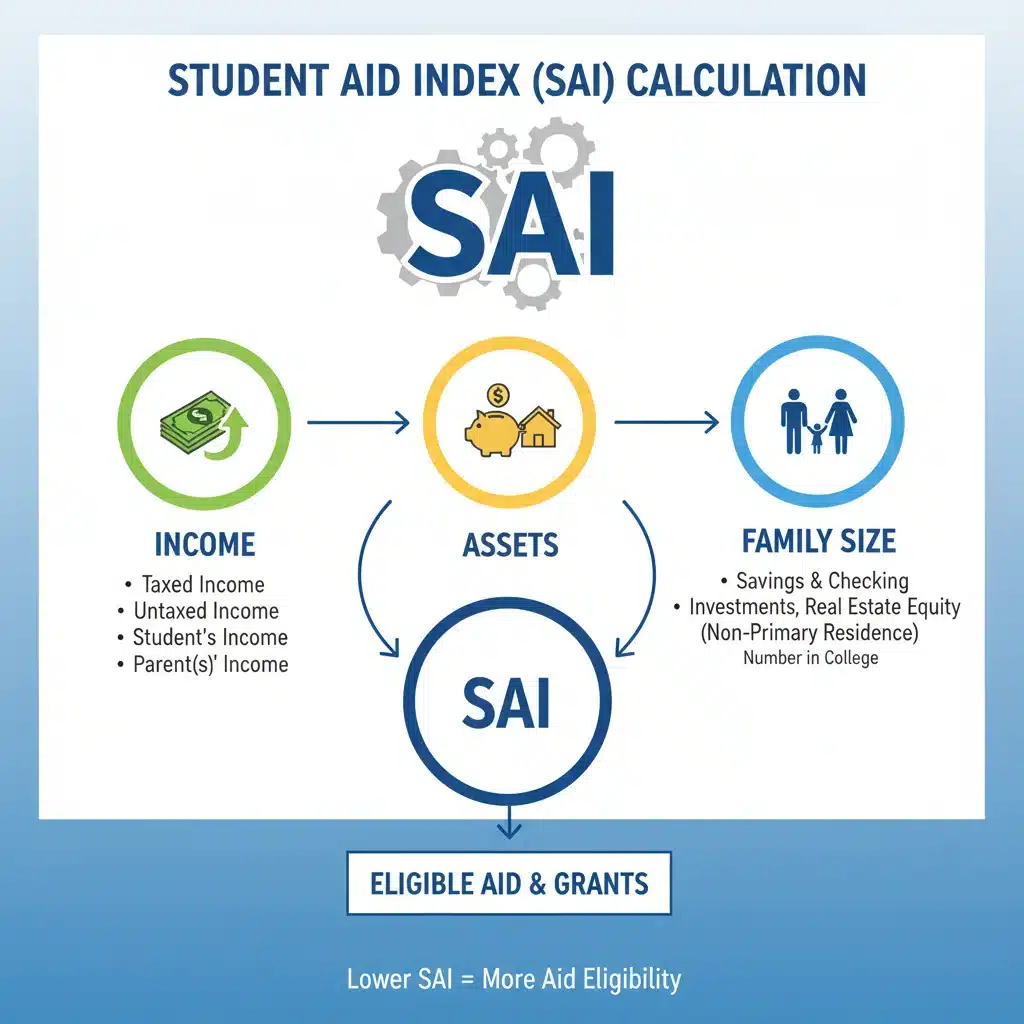
The SAI calculation considers several factors, similar to the EFC, but with some crucial modifications:
- Income: This remains a primary determinant. The FAFSA will use prior-prior year tax information (e.g., for the 2026-2027 FAFSA, 2024 tax information will be used).
- Assets: Savings, investments (excluding retirement accounts), and real estate (other than the primary residence) are considered. However, the calculation methods and allowances have been adjusted.
- Family Size: The number of people in the household and the number of students in college are still factors, though their weighting might have changed.
- Poverty Guidelines: A significant update is the increased use of federal poverty guidelines. For low-income families, the SAI calculation will provide larger income protection allowances, reducing the impact of income on the SAI.
- Child Support: Child support received will now be reported as an asset, not income, which can be beneficial for some families.
- Negative SAI: Unlike the EFC, the SAI can go as low as -1,500. A negative SAI indicates a high level of financial need and can qualify students for maximum Pell Grant awards and other need-based aid.
Impact of SAI on Aid Eligibility
A lower SAI generally translates to greater eligibility for need-based Federal Student Aid. The formula for determining financial need is:
Cost of Attendance (COA) - Student Aid Index (SAI) = Financial Need
Colleges then use this financial need figure to award various types of aid, including federal grants, institutional grants, subsidized loans, and federal work-study. For Federal Student Aid 2026, the shift to SAI means that many students, particularly those from lower-income backgrounds, may see an increase in their calculated financial need, potentially leading to more grant aid.
Pell Grants: Up to $7,395 and Expanded Eligibility for Federal Student Aid 2026
The Pell Grant program is the largest federal grant program for undergraduate students, providing need-based aid that does not have to be repaid. For the 2023-2024 award year, the maximum Pell Grant was $7,395. While the maximum award for 2026-2027 will be set closer to that time, it is expected to remain substantial, potentially at or above this amount, and its accessibility is set to expand significantly under the FAFSA Simplification Act.
How Pell Grant Eligibility is Determined
Under the new rules for Federal Student Aid 2026, Pell Grant eligibility will be determined in two main ways:
- Maximum Pell Grant Eligibility: Students whose parents or guardians are below 175% of the federal poverty level (or 225% for single-parent households) will automatically qualify for the maximum Pell Grant. This is a crucial change, as it provides a clear, direct path to maximum aid for a significant number of low-income students, regardless of their SAI.
- Scheduled Pell Grant Eligibility: All other students will have their Pell Grant eligibility determined by a look-up table, which considers their SAI in relation to the maximum Pell Grant and the college’s Cost of Attendance (COA). A lower SAI will result in a higher Pell Grant award.
This dual approach ensures that the lowest-income students receive the most significant support, while also providing proportional aid to others with demonstrated financial need. The expansion of Pell Grant eligibility is a cornerstone of the FAFSA Simplification Act’s goal to make higher education more affordable and accessible.
Maximizing Your Pell Grant Potential
To maximize your chances of receiving a Pell Grant for Federal Student Aid 2026, consider the following:
- Complete the FAFSA Accurately and On Time: This is the most critical step. Ensure all information is correct to avoid delays.
- Understand Your Family’s Financial Situation: Knowing where your family stands relative to the federal poverty level can give you an early indication of your Pell Grant potential.
- Consider Colleges with Lower COA: While Pell Grants are portable, the overall cost of attendance can impact your remaining financial need and the total aid package you receive.
- Maintain Satisfactory Academic Progress (SAP): To continue receiving Pell Grants in subsequent years, you must meet your college’s SAP requirements, which typically involve maintaining a certain GPA and completing a sufficient number of credits.
The FAFSA Application Process for Federal Student Aid 2026: What to Expect
While the FAFSA form has been simplified, the core process of applying for Federal Student Aid remains. For the 2026-2027 aid year, the FAFSA will typically open on October 1, 2025. However, due to the recent FAFSA rollout challenges, it’s always wise to check the official Federal Student Aid website for the most up-to-date information on the opening date.
Gathering Your Documents
Even with the direct data exchange with the IRS, you’ll still need some information on hand to complete the FAFSA efficiently. For Federal Student Aid 2026, you will need:
- Social Security Numbers: For yourself, your parents (if you’re a dependent student), and your spouse (if applicable).
- Driver’s License Number: If you have one.
- Alien Registration Number: If you are not a U.S. citizen.
- Federal Tax Information: Although transferred directly, having your 2024 federal tax returns (Form 1040) available can be helpful for reference.
- Records of Other Income: W-2 forms, untaxed income records (e.g., child support received, veterans’ non-education benefits).
- Bank Statements and Records of Investments: Current balances of cash, savings, checking accounts, and investments (stocks, bonds, mutual funds).

The Application Steps
- Create an FSA ID: Both the student and one parent (for dependent students) will need an FSA ID. This serves as your electronic signature and allows you to access federal student aid websites. If you already have one, ensure it’s active.
- Complete the FAFSA Online: Access the FAFSA form on studentaid.gov. The simplified form will guide you through the questions.
- Provide Consent for IRS Data Retrieval: This is a mandatory step. You and your contributors must consent to the direct transfer of federal tax information from the IRS.
- List Your Chosen Schools: You can list up to 20 colleges on your FAFSA. These schools will receive your FAFSA information.
- Review and Submit: Carefully review all information before submitting your FAFSA.
- Receive Your FAFSA Submission Summary: After submission, you’ll receive a FAFSA Submission Summary (FSS), which replaces the Student Aid Report (SAR). This document will detail your SAI and provide an estimate of your federal student aid eligibility. Review it for accuracy.
- Respond to Requests from Your College: Your chosen colleges may request additional documentation to verify your FAFSA information. Respond promptly to these requests.
Important Deadlines
There are three types of deadlines for Federal Student Aid 2026:
- Federal Deadline: This is the last day to submit the FAFSA for federal aid. It’s typically in June of the academic year for which you’re applying.
- State Deadlines: Many states have their own deadlines for state-specific financial aid, which can be much earlier than the federal deadline.
- College Deadlines: Individual colleges and universities often have their preferred or priority deadlines for financial aid. Meeting these can be crucial for accessing limited institutional aid.
It is always best practice to complete the FAFSA as soon as it opens to ensure you meet all possible deadlines and have the best chance at receiving the most aid.
Beyond FAFSA: Other Federal Student Aid Options for 2026
While the Pell Grant is a cornerstone of federal aid, it’s just one piece of the puzzle. Federal Student Aid 2026 encompasses a broader range of programs designed to support students financially.
Federal Student Loans
Federal student loans are a common way to cover educational costs. They often have lower interest rates and more flexible repayment options than private loans. For 2026, the types of federal loans available will include:
- Direct Subsidized Loans: Available to undergraduate students with demonstrated financial need. The government pays the interest while you’re in school at least half-time, during your grace period, and during deferment.
- Direct Unsubsidized Loans: Available to undergraduate and graduate students, regardless of financial need. Interest accrues while you’re in school.
- Direct PLUS Loans: Available to graduate or professional students and parents of dependent undergraduate students. These loans can cover up to the cost of attendance minus other aid received. A credit check is required.
It’s important to understand the terms and conditions of federal loans, including interest rates, loan limits, and repayment plans, before accepting them.
Federal Work-Study Program
Federal Work-Study provides part-time jobs for undergraduate and graduate students with financial need, allowing them to earn money to help pay for educational expenses. The program encourages community service work and work related to your course of study. Not all schools participate, and funding is limited, so early application through the FAFSA is key.
Other Federal Grants
- Federal Supplemental Educational Opportunity Grants (FSEOG): For undergraduate students with exceptional financial need. Priority is given to Pell Grant recipients.
- Teacher Education Assistance for College and Higher Education (TEACH) Grants: For students who agree to teach in high-need fields in low-income areas after graduation.
- Iraq and Afghanistan Service Grants: For students whose parent or guardian died as a result of military service in Iraq or Afghanistan after 9/11.
Eligibility for these grants can vary, so it’s important to explore all options when considering Federal Student Aid 2026.
Strategies for Success: Navigating Federal Student Aid 2026
Successfully securing Federal Student Aid for 2026 requires more than just completing the FAFSA. It involves strategic planning, diligence, and a proactive approach.
Start Early and Be Thorough
The importance of applying early cannot be overstated. Many federal and state aid programs have limited funding, often awarded on a first-come, first-served basis. Submitting your FAFSA as soon as it opens increases your chances of receiving available funds. Additionally, thoroughly review your application for any errors. Even minor mistakes can delay processing and impact your eligibility.
Understand Your Award Letter
Once you’ve been accepted to a college and your FAFSA has been processed, you’ll receive a financial aid award letter. This letter outlines the total cost of attendance and the various types and amounts of aid you’ve been offered. Carefully compare award letters from different schools. Understand the difference between grants (money you don’t repay) and loans (money you do repay). Don’t be afraid to contact the financial aid office at your prospective schools if you have questions or need clarification.
Consider Special Circumstances
Life events can unexpectedly impact a family’s financial situation. If your family has experienced a significant change in income or assets since the tax year used for your FAFSA (e.g., job loss, divorce, death of a parent, high medical expenses), you may be able to appeal your financial aid package. Contact the financial aid office at your chosen institution to discuss a “professional judgment” review. They may be able to adjust your SAI to reflect your current financial reality, potentially increasing your eligibility for Federal Student Aid 2026.
Explore State and Institutional Aid
While this article focuses on Federal Student Aid, remember that states and individual colleges also offer significant financial assistance. Many state grant programs require FAFSA completion. Institutional scholarships and grants are often merit-based or need-based and can substantially reduce the cost of attendance. Research these options thoroughly in conjunction with your federal aid application.
Beware of Scams
Unfortunately, financial aid scams exist. Be wary of services that charge a fee to complete your FAFSA (it’s free!) or guarantee scholarships for a price. Always use official government websites (studentaid.gov) and communicate directly with your college’s financial aid office.
The Long-Term Impact of Federal Student Aid Updates
The changes to Federal Student Aid for 2026 and beyond are not just about a single application cycle; they represent a long-term commitment to improving access to higher education. By simplifying the FAFSA and expanding Pell Grant eligibility, the government aims to reduce barriers for millions of students, particularly those from underserved communities.
These reforms are expected to:
- Increase College Enrollment: By making financial aid more accessible and predictable, more students may feel confident pursuing a college education.
- Reduce Student Debt: With increased grant aid, students may rely less on loans, leading to lower overall student debt burdens.
- Promote Educational Equity: The enhanced focus on low-income families and the direct path to maximum Pell Grants will help level the playing field for students from diverse socioeconomic backgrounds.
- Streamline Financial Aid Administration: The direct data exchange with the IRS and the simplified FAFSA reduce the administrative burden on both applicants and financial aid offices.
However, it’s also important for students and families to remain informed about potential future adjustments. The financial aid landscape is dynamic, and staying updated with official announcements from the U.S. Department of Education is always recommended.
Conclusion: Your Path to Affordable Education in 2026
The Federal Student Aid updates for 2026 bring both new opportunities and responsibilities for students seeking to fund their higher education. The simplified FAFSA, the introduction of the Student Aid Index (SAI), and the expanded eligibility for Pell Grants, potentially up to $7,395, are designed to make the process smoother and more beneficial for a wider range of students.
Your journey to an affordable education begins with understanding these changes and taking proactive steps. Complete your FAFSA accurately and on time, understand how your SAI impacts your aid, and explore all available federal, state, and institutional aid options. By doing so, you can significantly reduce the financial burden of college and focus on achieving your academic and career goals.
Remember, the resources are there to help you. Utilize the official Federal Student Aid website, consult with your high school counselor, and engage with college financial aid offices. With careful planning and informed action, Federal Student Aid 2026 can be your key to unlocking a bright and affordable future in higher education.